

Which Implant Crown Attachment is Right for You?
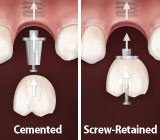 Dental implants have come a long way since their introduction thirty years ago. Unlike their predecessors, today’s implants come in various shapes and sizes that can meet the precise needs of individual patients. Crown attachment has also developed some variety.
The actual implant is a titanium post surgically imbedded in the jawbone to replace the original tooth root. The restoration crown, the visible part of the implant system that resembles natural tooth, is affixed to the implant post. There are two basic methods to attach the crown: cement it to an abutment that has been installed in the implant; or screw it into the implant with a retaining screw from the underside of the crown. In the latter case, the abutment has been built into the crown.
While either method provides years of effective service, one method may work better than the other depending on the circumstance. Screw-retained crowns require no cement and are more easily removed than cemented crowns if it becomes necessary. On the other hand, the screw access hole can be visible, although the area can be filled with a tooth-colored filling; and although rare, chips near the access hole can occur. Occasionally the screw may become loose, but tightening or replacing the retaining screw is a simple matter because of the access hole.
A cemented crown looks more like a natural tooth and so is more useful in situations where cosmetics are a factor. The cement, however, can cause inflammation and contribute to bone loss in some patients when excess cement gets below the gums. Unlike a screw-retained crown, removal is more difficult and limited.
As a rule, screw-retained crowns are normally used in areas where the screw hole is not conspicuous, such as for posterior (back) teeth. They’re also more desirable than cemented when the implant is permanently crowned at the same time it’s surgically implanted, a process called “immediate loading.”
Which method of crown attachment is best for you? That depends on the implant location and other factors we would explore during a thorough pre-implant exam. Either way, the end result will be a life-like replica of your natural teeth, and a restored, vibrant smile.
If you would like more information on crown attachment to dental implants, please contact us for a consultation.
Dental Implants Services Offered By Top Dentist In Fraser
 Supermodel Christie Brinkley has a one-in-a-million smile, but she is just one of millions who have benefited from today's preferred tooth-replacement technique: the dental implant. In a wide-ranging interview, Brinkley told Dear Doctor magazine about a helicopter accident she suffered while back-country skiing.
“I fractured two molars in the back of my mouth and I had to get two dental implants,” Brinkley told the magazine. “I am grateful for the dental implant technology that feels and looks so natural.”
You might think it serves little purpose to replace a missing back tooth that was barely visible in your smile to begin with — especially if you don't spend a lot of time posing for magazine covers. But this is actually not the case. Your molars are extremely important for chewing and even for maintaining a more youthful appearance.
Dentists generally agree that losing posterior (back) teeth can have many consequences for the remaining teeth and their surrounding structures, i.e., bone and gums. If back teeth are missing, the front teeth end up bearing more stress than they were built for. And there are certain things that happen when any tooth is lost, whether front or back, that can affect function and appearance.
For one thing, when a tooth is lost the adjacent teeth tend to drift into the empty space or tip towards it. This can adversely affect your bite. Too much shifting can render a tooth basically useless and also leave it more vulnerable to gum disease.
Another complication is the loss of tooth-supporting bone that inevitably occurs when teeth are lost. When a tooth comes out, the bone under it actually begins to melt away. Since back teeth support the vertical dimension of the face, their loss can cause what's known as “bite collapse” — a reduction in facial height that becomes increasingly noticeable over time and can make you look older.
A dental implant can prevent all of these things, while providing you with a replacement that looks and feels just like the tooth you lost.
If you are interested in learning more about implants, please contact us for a consultation.
Fraser Porcelain Veneers
 If your teeth are stained and discolored, misshapen or too small, porcelain veneers may be just the opportunity to treat yourself to a beautiful smile that can last for decades. They may be used to restore a single tooth that is broken or stained, or many teeth that are worn or discolored. If you have small teeth with gaps between them, veneers can close the spaces.
Porcelain laminate veneers are thin layers of dental restorative material that are bonded onto your teeth. With porcelain laminate veneers you can change a tooth's shape, size, and color. They require a minimal amount of tooth preparation (reduction of enamel on the original tooth) and are a great way to help you have a beautiful smile now and for decades to come.
They can last from seven to twenty years or more. Part of what determines their exact longevity is the health of your mouth. Gum tissues may deteriorate and the gum line may shrink back away from the roots of your teeth. So brushing, flossing, and other good dental habits are important in maintaining your investment in your smile.
Veneers don't require special treatment, and you can eat nearly anything with them. Keep in mind one precaution, however. Porcelain, like glass, can break with too much stress. This means that biting something that applies a strong twisting movement to your teeth may cause the veneers to shatter. If you grind your teeth at night you may need to wear a night guard to protect your veneers. It doesn't happen often, but if a veneer detaches it can usually be rebonded to the tooth.
Contact us today to discuss your questions about porcelain veneers and see if they are right for you to enhance or change your smile.
 Dr. Nawar Sileewa D.D.S (The Tooth Booth) 32560 Utica Road Fraser , MI 48026
 (586) 293-8530